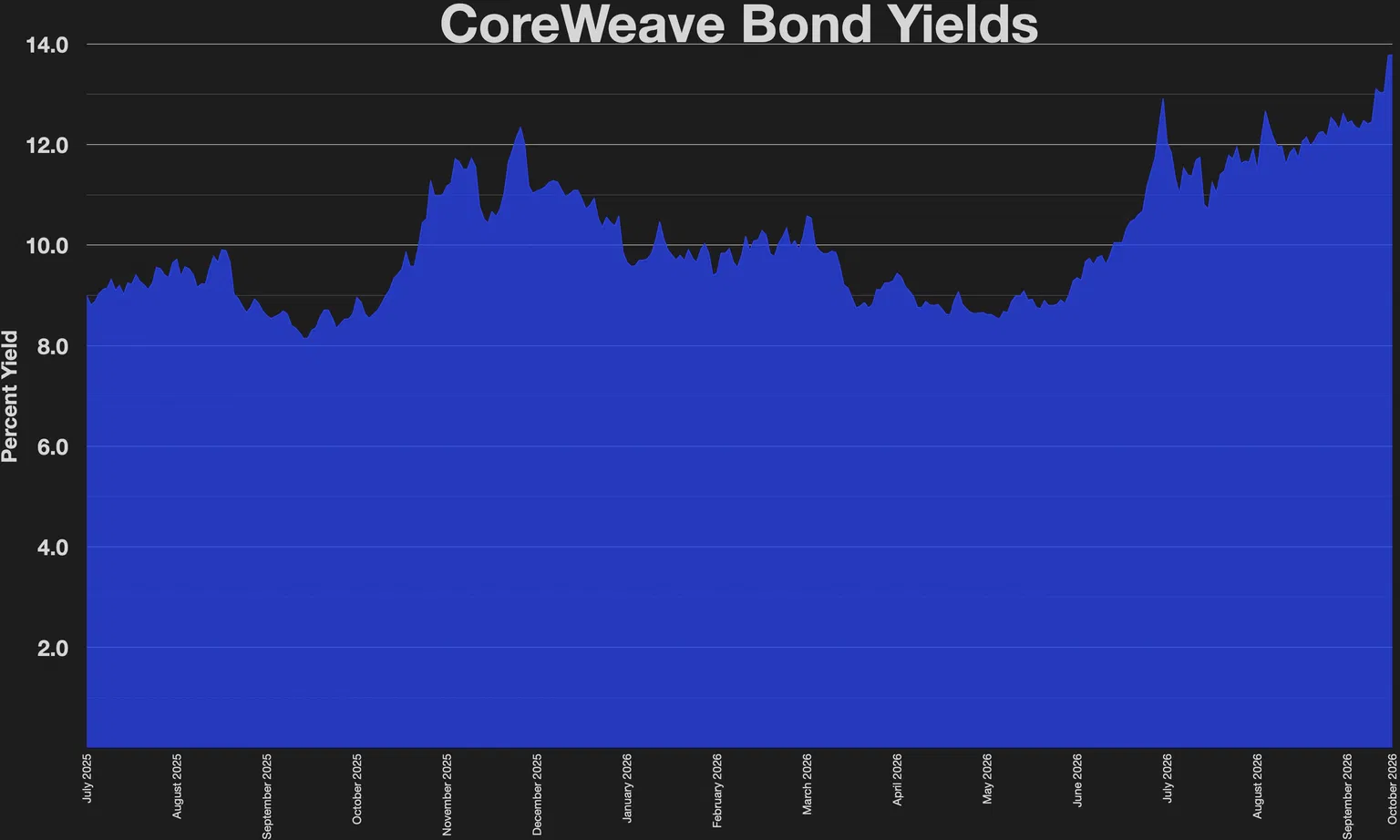
CoreWeave stock (NASDAQ: CRWV) has entered its most turbulent stretch since going public, as a sudden repricing of AI-infrastructure debt sent shares into a tailspin. The stock tumbled more than 15% on October 14, 2026, and kept sliding in the sessions that followed, closing near $61 on October 16 — roughly 59% below its 52-week high of $150.40. The catalyst was not a revenue miss or a lost customer. Instead, investors turned on the AI cloud provider's balance sheet, where roughly $50 billion in debt now carries a junk-grade B+ rating and yields on its bonds have surged toward 15%. The credit market is flashing a warning: the cost to insure CoreWeave's debt against default has jumped to roughly 1,000 to 1,200 basis points, implying about a 63% chance of default within five years. For a company that still ranks among the fastest-growing names in AI infrastructure, the sell-off is a stark reminder that hypergrowth financed with borrowed money can unravel quickly when confidence in AI spending wavers.
How a Debt-Fueled AI Juggernaut Hit a Wall
CoreWeave was never a conventional cloud company. Founded in 2017 by Michael Intrator, Brian Venturo, and Brannin McBee, it began as a cryptocurrency mining operation before pivoting into what it calls "The Essential Cloud for AI" — renting out high-performance Nvidia GPU clusters to companies training and running large AI models. That pivot made it one of the defining stories of the AI boom. Its initial public offering in March 2025 priced at $40 per share, the biggest U.S. tech listing since 2021, and the stock eventually peaked above $150 in October 2025, minting billionaires among its founders.
The underlying business kept accelerating. CoreWeave reported $2.575 billion in second-quarter 2026 revenue, up 112% year over year, and disclosed a revenue backlog of roughly $104.2 billion — contracted demand that excludes more than $25 billion in additional arrangements. Microsoft alone accounted for about 67% of 2025 revenue, and the company expanded a deal with OpenAI by as much as $6.5 billion. Nvidia, its most important partner, committed another $2 billion in January 2026 to help build out 5 gigawatts of AI data center capacity by 2030.
The problem is how that growth is being funded. CoreWeave has financed its data center buildout almost entirely with debt, borrowing tens of billions of dollars to buy Nvidia chips and construct facilities. Total debt now stands near $50 billion, and interest expense is climbing every quarter. When rates stayed low and AI demand seemed insatiable, lenders were happy to fund the buildout. In October 2026, that calculus broke down. The 9.625% bond due in 2032 climbed to about 14.8%, the 9.75% note due in 2031 hit roughly 14.9%, and the 2031 maturity briefly surged past 16%. Credit default swaps — insurance against default — hit record levels, and the company's bonds now trade at roughly 77 to 81 cents on the dollar. "The market is waking up to the fact that AI [infrastructure] is being financed with an enormous amount of debt," credit analysts warned, and the scare rippled across the sector, dragging down peers such as Nebius.
Timeline: From Record IPO to a 59% Stock Plunge
- March 28, 2025: CoreWeave prices its IPO at $40 per share and debuts on the Nasdaq under the ticker CRWV, raising about $1.5 billion in the biggest U.S. tech IPO since 2021.
- October 16, 2025: The stock hits its 52-week high of $150.40.
- January 2026: Deutsche Bank upgrades CRWV to Buy with a $140 price target, citing growth momentum.
- January 26, 2026: Nvidia commits an additional $2 billion to CoreWeave for its 5-gigawatt data center push.
- June 22, 2026: CoreWeave joins the Nasdaq-100 Index, just 15 months after its IPO.
- August 10-11, 2026: The company closes a $2.6 billion loan facility and reports Q2 revenue of $2.575 billion, up 112% year over year, with a $104.2 billion backlog.
- October 8, 2026: A report on OpenAI's roughly $50 billion annualized revenue rattles AI stocks, including Nvidia, Oracle, and CoreWeave.
- October 14, 2026: CoreWeave stock plunges more than 15% as its bond yields near 15% and credit default swap spreads hit distress levels. CEO Michael Intrator blames the market for "acting irrationally."
- October 16, 2026: The stock closes near $61, down about 59% from its high, after another double-digit decline.
The Numbers Behind the Panic: $104 Billion of Demand vs. $50 Billion of Debt
The bull case rests on the staggering revenue backlog of $104.2 billion, which grew 246% year over year. That is contracted, committed demand from some of the biggest names in AI, and it suggests CoreWeave does not have a demand problem — it has a funding problem. Supporters also point to the Nvidia backstop: Nvidia has agreed to cover unsold GPUs in certain facilities, reducing the risk that CoreWeave is left with idle, expensive hardware. On fundamentals, the company beat earnings estimates in Q2, with EPS topping consensus by $0.27, and management now targets $960 million to $1.15 billion in adjusted operating income for 2026 on a full-year revenue range of $12 billion to $13 billion.
The bear case is simpler and, right now, louder: CoreWeave is loss-making and owes nearly $50 billion, and the market has suddenly decided that debt is too risky to hold. When a junk-rated borrower's bonds yield 15%, refinancing becomes punishing. Every new dollar of capital costs more, squeezing the very margins the growth story depends on. Credit traders have pushed CoreWeave's CDS to levels implying a 63% chance of default within five years — up from roughly 30% a year earlier — a dramatic repricing that says the market no longer treats AI demand as guaranteed. The scare is also contagious: Nebius fell more than 12% in a single session as investors reassessed every "neocloud" balance sheet.
Compounding the sentiment problem is insider selling. CoreWeave's three co-founders — Intrator, Venturo, and McBee — have sold roughly $3.3 billion in shares since the IPO, including about $2.4 billion in a recent stretch. Insider sales are not inherently bearish, but when they coincide with a collapsing stock and rising default odds, investors read them as a vote of no confidence.
Analysts remain formally bullish on average — roughly 38 to 41 analysts carry a consensus Buy rating with a price target near $140, and some targets run as high as $250 to $300 — but the gap between those targets and a $61 stock price underscores how much the debt overhang has distorted the valuation debate.
Where CoreWeave Stock Stands Today
As of the latest sessions, CoreWeave shares have stabilized only modestly after the worst of the selling. The stock closed near $61.39 on October 16, down nearly 12% on the day and roughly 59% below its October 2025 peak, leaving a market capitalization of about $34 billion. The company has not announced a new equity raise or a formal restructuring, and management's public posture remains defiant — Intrator has dismissed the bond-market reaction as irrational and emphasized the strength of underlying demand. The Nvidia backstop remains in place, and the $2.6 billion loan facility closed in August provides near-term liquidity. Still, the bond market's verdict is hard to ignore: with debt trading around 77 to 81 cents on the dollar and CDS spreads at record highs, CoreWeave is now being priced, at least partially, as a credit risk rather than a pure growth story.
What Happens Next for CRWV
The road ahead hinges on two questions: Can CoreWeave refinance or service its debt on manageable terms, and will AI infrastructure demand keep growing fast enough to validate the buildout? If bond yields stay elevated, the company may be forced to slow capital spending, issue equity at depressed prices, or both — any of which could pressure the stock further. Conversely, if CoreWeave converts even a fraction of its $104 billion backlog into high-margin revenue and demonstrates that interest costs are coming down, the current valuation could look like an overreaction. Analysts and credit investors will be watching the next earnings report, any changes to financing plans, and whether Nvidia or other strategic partners step in with additional backstops. For investors, the key risk is not that AI demand disappears — it is that the cost of capital needed to serve that demand becomes too expensive to make the business work.
The Bottom Line: Key Takeaways for Investors
- CoreWeave stock has fallen roughly 59% from its 52-week high of $150.40 to near $61 amid a debt-driven sell-off.
- The company carries about $50 billion in debt with a junk-grade B+ rating; its bonds now yield near 15%.
- Credit default swaps imply a roughly 63% chance of default within five years, up from about 30% a year earlier.
- The underlying business is still growing fast: Q2 2026 revenue rose 112% to $2.575 billion, backed by a $104.2 billion revenue backlog.
- The co-founders have sold about $3.3 billion in stock since the March 2025 IPO.
- The analyst consensus remains Buy with a target near $140, but the gap between price and targets reflects deep uncertainty about the debt-funded model.