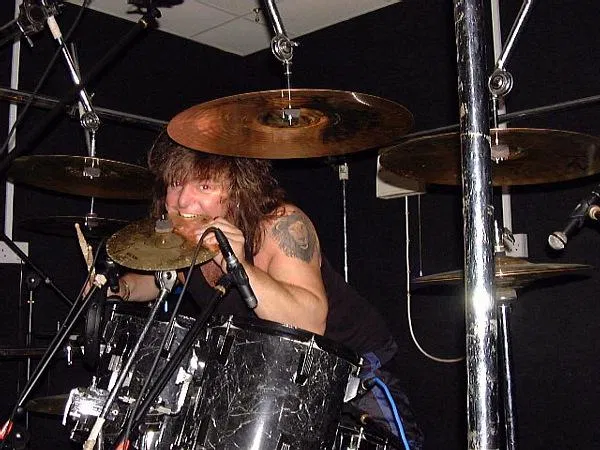
Name: Nigel Durham
Age: 61
Birthday: August 25, 1965
Born: Rotherham, South Yorkshire, United Kingdom
Net Worth: Approximately $1 million
Fun Fact: Months before his death, Durham debunked a false online report of his own passing by telling fans he was "still alive & kickin."
Nigel Durham, the English heavy metal drummer who powered Saxon's 1988 album Destiny and later anchored Oliver/Dawson Saxon for more than a decade, died in October 2026 at the age of 61. Saxon confirmed the news on social media on 24 October 2026, remembering him as "not only a truly great drummer, but also a very humble and friendly guy." For fans of the New Wave of British Heavy Metal, Durham's passing closed the book on a working musician whose career behind the kit spanned roughly 45 years — and whose fortune, while never publicly disclosed, was earned the old-fashioned way: record after record and tour after tour.
From South Yorkshire to the Heavy Metal Stage
Nigel Durham was born on 25 August 1965 in Rotherham, South Yorkshire, the industrial heartland of England that also produced Saxon themselves. He cut his teeth on the local rock circuit of the 1980s, most notably as the drummer for Monroe, a Sheffield-based glam rock band. Those early years taught Durham the fundamentals of a touring musician's life — playing small clubs, cutting demos and building the stamina that would later carry him into bigger venues.
Like many British rock drummers of his generation, Durham was a hired gun first and a songwriter second. That distinction mattered enormously to his earnings. In the music business, songwriting royalties are where lasting wealth is made; drummers and other band players typically earn their money instead from recording fees, advances and, above all, live touring.
Joining Saxon and Recording Destiny
Durham's big break came in early 1987, when Saxon's long-serving drummer Nigel Glockler left and Durham was brought in as his replacement. He stayed for nearly two years and played on a single studio album — Destiny, Saxon's ninth record, released on 20 June 1988. The album remains notable for being the only Saxon release to feature the rhythm section of Durham on drums and Paul Johnson on bass.
By the late 1980s, however, Saxon were past their commercial peak, having racked up eight UK Top 40 albums earlier in the decade. Destiny did little to reverse that decline, and Durham had moved on by 1989. Even so, a stint in a legendary NWOBHM band carried real weight: the Saxon name gave Durham credibility and steady work for decades, and his playing on Destiny continued to produce modest royalty payments as the record was reissued and compiled over the years.
Life After Saxon: Oliver/Dawson Saxon and Morpheus Rising
For most of the next two decades, Durham remained a fixture of the British hard rock scene. Around 2000 he joined Oliver/Dawson Saxon, the group formed by ex-Saxon members Graham Oliver and Steve Dawson, and stayed behind the kit for roughly ten years. With them he recorded the well-received 2010 album Motorbiker, which featured the live favourite "Whipping Boy."
In 2013 Durham signed on with the York-based rockers Morpheus Rising, playing on their 2014 album Eximius Humanus before departing in 2016. He also worked with a string of smaller projects, including the Matt Black Band. None of these gigs made him a household name, but together they formed the steady, unglamorous career of a professional musician — the kind that keeps the bills paid through a mix of live fees, session work and occasional royalties.
How Nigel Durham Built His Wealth
Durham's income flowed from the same sources that sustain most career drummers. Live performance was the largest: whether with Saxon, Oliver/Dawson Saxon or Morpheus Rising, touring and festival appearances provided the bulk of his earnings. Recording and session fees followed, and finally there were royalties — though as a drummer who rarely received songwriting credits, Durham's royalty stream was far smaller than that of frontmen and principal songwriters.
It is also worth noting what Durham was not: he was never an arena-headlining rock star with nine-figure accounts. He was a respected, hard-working sideman. His death was confirmed months after a bizarre false report in April 2026 claimed he had passed — a rumour Durham himself debunked in July 2026 by telling fans he was "still alive & kickin." Saxon announced his actual passing on 24 October 2026, sending love to his wife Lauretta, daughter Gemma and grandchildren. A cause of death was not disclosed.
Nigel Durham's Net Worth
Nigel Durham's net worth has never been publicly established, and little verified financial information exists about his personal wealth. Based on a career spanning roughly 45 years as a session and touring drummer — including his time with Saxon, more than a decade with Oliver/Dawson Saxon, and work with Morpheus Rising — financial observers generally estimate his fortune to have been in the range of $1 million. That figure reflects a lifetime of steady gigging rather than any superstar windfall.
In the end, Durham's real legacy cannot be measured in money. It lives in the thunderous drum tracks he laid down on records like Destiny and Motorbiker, in the tribute paid by Saxon, who remembered a "powerhouse drummer," and in the fans who mourned a musician described again and again as humble, friendly and fiercely devoted to his craft. By that standard, Nigel Durham died a rich man indeed.