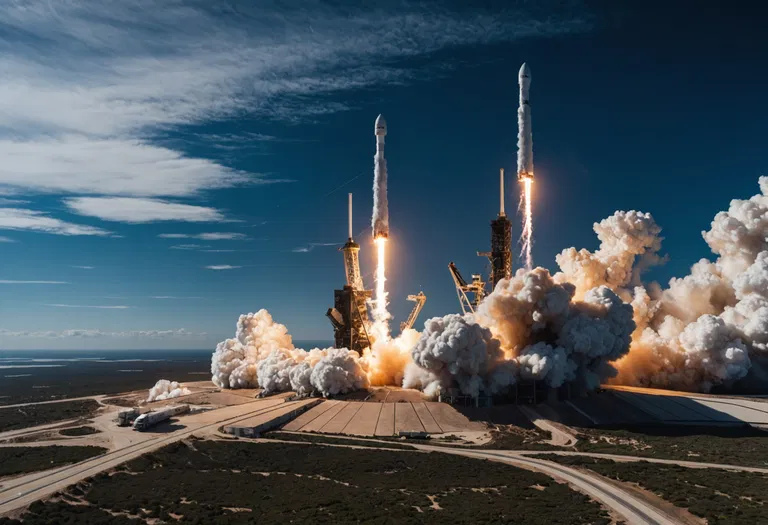
SpaceX stock (SPCX) has been on one of the wildest rides in recent market history — soaring after the largest IPO ever recorded, crashing below its offer price, and then rebounding sharply on its first-ever profit as a public company. After debuting on the Nasdaq at $150 in June 2026 and touching a 52-week high of $225.64, the stock collapsed to a low of $104.83 as a bond sale, an aborted Starship launch, and a flood of insider lockup expirations spooked investors. Now, powered by surging artificial-intelligence revenue, shares have clawed back roughly 24% over the past year and trade near $141. Here is what drove the turbulence and where the stock goes from here.
How SpaceX Pulled Off the Biggest IPO in History
On June 11, 2026, SpaceX priced 555.6 million shares at $135 apiece, raising $75 billion in the largest initial public offering ever recorded — easily topping Saudi Aramco's $29.4 billion listing in 2019. The deal implied a valuation of roughly $1.77 trillion, and demand was so intense that the offering was oversubscribed about four times, with retail orders alone reportedly exceeding $70 billion.
When trading began the next day under the ticker SPCX, shares opened at $150, an 11% premium to the IPO price, and surged to an intraday high of $225.64 before closing near $161. At those levels, SpaceX was valued at more than $2 trillion, and the windfall made Elon Musk — the company's founder and largest shareholder — the world's first trillionaire, with a net worth of roughly $1.1 trillion, according to the Bloomberg Billionaires Index.
The euphoria, however, did not last.
Timeline: From a $225 High to a 52-Week Low — and Back
The stock's descent was rapid, but its recovery has been just as notable. Here is how the arc unfolded:
- June 11, 2026 — SpaceX prices its IPO at $135, raising a record $75 billion at a $1.77 trillion valuation.
- June 12, 2026 — SPCX debuts on the Nasdaq, opens at $150 and closes near $161; Musk becomes the first trillionaire.
- June 22–23, 2026 — Shares fall 16.4% on June 22 to $154.60 as SpaceX launches a $20 billion bond sale; the next day SPCX sinks 9% and briefly loses its $2 trillion market-cap floor.
- July 15–17, 2026 — The stock dips below its $135 IPO price; an aborted Starship test flight pushes it into a five-day losing streak and a low near $126.
- August 4, 2026 — In its first earnings report as a public company, SpaceX posts revenue of $7.8 billion (up 92%) but a loss of $0.09 per share; the stock still drops 8%.
- Fall 2026 — Successive lockup expirations free hundreds of millions of insider shares, driving the stock to a 52-week low of $104.83.
- October 21, 2026 — SpaceX reports its first profit as a public company — $4.4 billion in net income on $14.6 billion in revenue — as AI revenue nearly triples to $7.6 billion; shares jump 9.5% to $161.82.
- November 2026 — The stock trades near $141, up about 9% over the prior four weeks and 24% over the past 12 months.
Why the Stock Crashed — and Why It Came Back
The post-IPO slide was not driven by a single event but by a series of overlapping pressures. The first crack came when SpaceX announced a $20 billion bond issuance to refinance debt just days after raising $75 billion in equity. Investors read the move as a sign the company needed more capital sooner than expected, and shares sank 9% in a single session, briefly pushing the valuation below the symbolic $2 trillion mark.
Then came operational setbacks. On July 16, SpaceX aborted a Starship test flight, reigniting concerns about the timeline for its flagship deep-space program. Finally, lockup expirations began to bite as early employees and private investors — many of whom had acquired shares in earlier tender offers at prices of $112 or less — moved to lock in gains. In early August, roughly 911.5 million insider shares became eligible to trade, and subsequent expirations added further supply pressure, eventually driving the stock to its $104.83 low.
The rebound, by contrast, has been powered by fundamentals. In its third-quarter report, SpaceX delivered its first profit as a public company, with net income of $4.4 billion on revenue of $14.6 billion. Crucially, AI-related revenue nearly tripled to $7.6 billion, surpassing Starlink and underscoring the company's emerging role as an artificial-intelligence infrastructure provider. Starlink itself doubled its customer base to 12 million, adding a fast-growing, recurring revenue stream.
Despite the volatility, Wall Street has largely maintained a constructive view. The stock carries a consensus Buy rating, and some analysts have set 12-month price targets around $256, implying more than 70% upside from recent levels.
Where SpaceX Stock Stands Now
As of early November 2026, SPCX trades near $141, with a 52-week range of $104.83 to $225.64. The stock has gained about 9% over the prior four weeks and roughly 24% over the past 12 months, according to market data. While shares remain well below their post-IPO peak, the company has solidified its position as one of the most valuable public companies in the world, with a market capitalization still measured in the trillions of dollars.
What's Next for SpaceX Stock
The next major tests for the stock will be continued execution on the Starship program, which analysts view as central to the long-term investment case, and the durability of its AI revenue growth. Investors will also watch whether Starlink can keep scaling toward profitability and whether the company resumes insider tender offers at higher valuations. If AI momentum and launch milestones continue, some analysts see a path toward the $250 range over the next 12 months. If setbacks return or insider selling resumes in force, the stock could remain range-bound near current levels.
The Bottom Line: Key Takeaways
- SpaceX completed the largest IPO in history in June 2026, raising $75 billion at $135 per share.
- Shares surged to a high of $225.64 before crashing to a 52-week low of $104.83.
- A bond sale, an aborted Starship launch, and lockup expirations drove the decline.
- The stock rebounded after SpaceX posted its first profit — $4.4 billion in Q3 — powered by AI revenue that nearly tripled to $7.6 billion.
- SPCX now trades near $141, and analysts maintain a Buy rating with a 12-month target near $256.