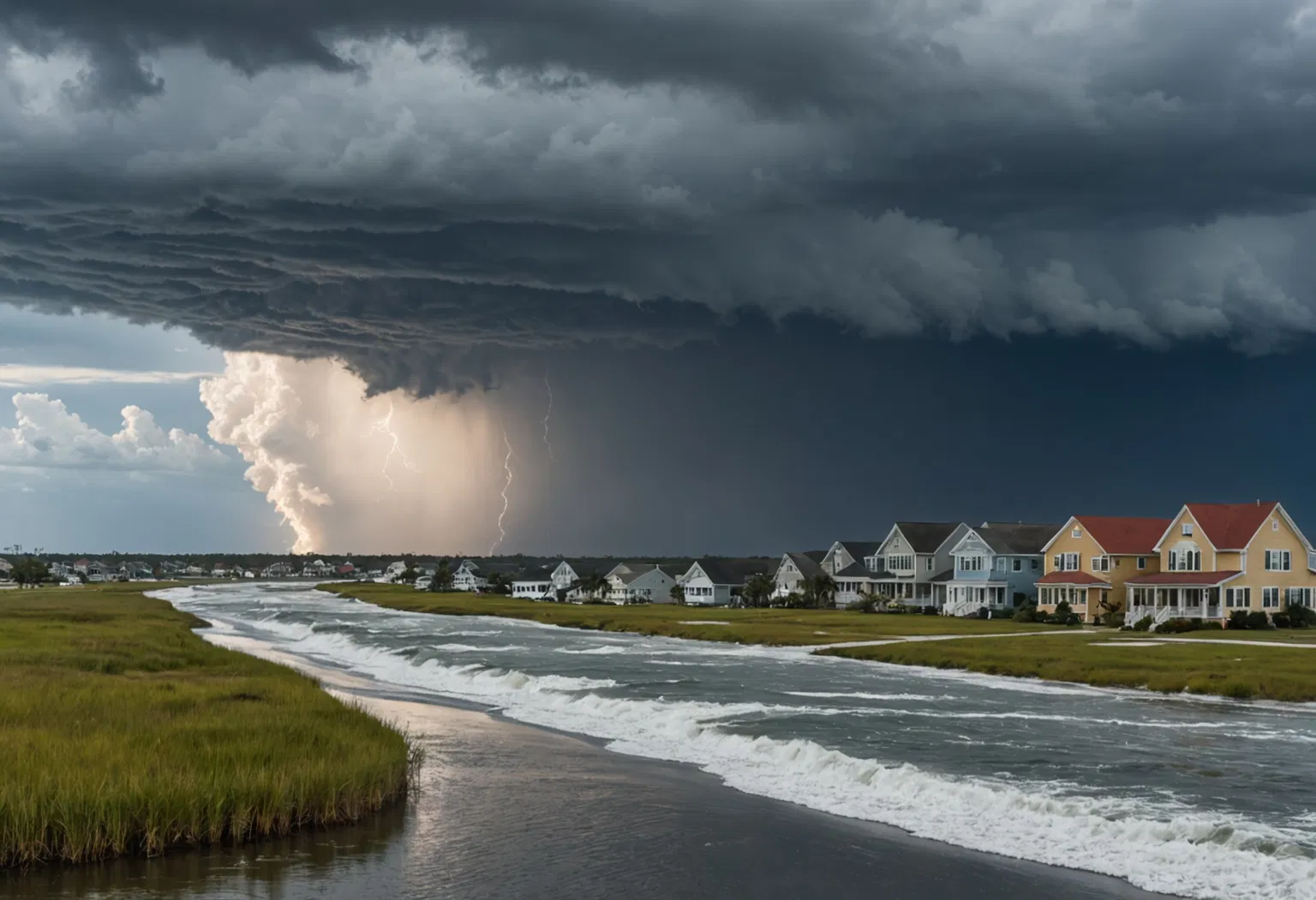
Hurricane Isaias — the first named hurricane of the 2026 Atlantic season — crashed ashore near Destin, Florida, late Friday as a Category 2 storm with sustained winds of 105 mph, and the financial shockwaves are only beginning to be measured. Early projections put insured losses in the low- to mid-single-digit billions of dollars, while energy companies shut in roughly 72% of Gulf of Mexico oil production ahead of landfall. For investors in insurance, reinsurance, energy and infrastructure, the critical question is not whether Isaias will leave a mark on markets — it is where the damage lands and who ultimately absorbs the cost.
Isaias briefly intensified into a major Category 3 hurricane with maximum winds near 120 mph before weakening slightly as it approached the coast, according to the National Hurricane Center. At least four people were killed — two when trees fell onto homes in Escambia County, Florida, and Birmingham, Alabama — and nearly 700,000 customers were without power at the peak of the outages. Forecasters warn that inland flooding across the Southeast remains a live threat in the days ahead.
Billions at Stake: The Scale of Isaias's Damage
The most consequential number for investors right now is the insured loss estimate, and the early read is manageable but not trivial. Brokers and catastrophe modelers put preliminary insured losses in the low- to mid-single-digit billions of dollars, with The Insurer reporting that Isaias could drive up to $5 billion in insured losses. Guy Carpenter, the reinsurance brokerage, likewise pegged the potential in the mid-single-digit billions of dollars, drawing on historical analogs including Hurricanes Opal and Dennis.
The property at risk is enormous. Risk data firm Cotality estimates Isaias threatened roughly 777,000 homes along the northern Gulf Coast with a combined reconstruction value of about $241.6 billion. Within the storm-surge warning area alone, Cotality counted 342,000 homes representing $101.5 billion in reconstruction value. Insurance Business reported that $71.8 billion in Gulf Coast commercial property sat in the storm's path — a reminder that economic and insured costs will diverge sharply, with a meaningful share of losses borne by homeowners, businesses and public entities rather than insurers.
From Category 3 to Landfall: How Isaias Unfolded
Isaias's march toward the Gulf Coast moved quickly, and markets responded in real time:
- Early October: Isaias forms and enters the Gulf of Mexico, becoming the first hurricane of an otherwise quiet 2026 Atlantic season.
- Oct. 7–8: The system rapidly intensifies into a Category 3 major hurricane, prompting offshore energy producers to begin evacuating platforms and shutting in wells.
- Oct. 9: Isaias makes landfall near Destin, Florida, around 8:30 p.m. CDT as a Category 2 storm with 105 mph winds and a roughly five-foot storm surge.
- Oct. 9–10: The storm plows inland through Alabama and the Southeast, leaving four dead and nearly 700,000 customers without power at the peak.
Throughout the approach, the Bureau of Safety and Environmental Enforcement tracked a steady climb in shut-in production, and Reuters reported shut-ins equaled nearly 72% of Gulf oil output and 59% of natural gas production as Isaias neared landfall.
Why Wall Street Isn't Panicking — and Where It Should Watch
Here is the counterintuitive part for investors: a multibillion-dollar October hurricane is unlikely to move the needle on insurance pricing. Brokers told Business Insurance that expected Isaias losses are not likely to meaningfully influence Jan. 1, 2027, reinsurance renewals, thanks to the abundance of available reinsurance capital accumulated after several relatively benign loss years. One Louisiana industry executive told FOX 8 that reinsurers typically carry on the order of $100 billion in capacity and have had essentially no losses so far, leaving ample room to absorb a single-digit-billion event.
In fact, the broader reinsurance market was already heading into 2027 with a softening bias. Analysts have projected property catastrophe rates could fall on the order of 10% at the Jan. 1 renewal. A storm like Isaias — painful locally but modest by industry standards — is more likely to reinforce that trend than reverse it. For catastrophe bond and insurance-linked securities (ILS) investors, the takeaway is similar: single-digit-billion events typically fall well short of trigger thresholds, leaving most cat bonds untouched.
Where investors should pay closer attention is energy. Isaias forced the evacuation of 129 production platforms — roughly 35% of the 371 staffed platforms in the Gulf — and shut in an estimated 1.28 million barrels per day of crude production, according to OilPrice.com, with some tallies running as high as 1.5 million barrels per day. Onshore, the storm's path threatened Chevron's refinery in Pascagoula, Mississippi, and Vertex's refinery in Saraland, Alabama, while CBS News reported that roughly 15% of U.S. refining capacity sat in the storm's crosshairs. With crude prices already elevated before the storm, analysts have warned that gasoline prices could tick higher if refineries lose power or suffer damage.
Natural gas is in the mix as well: roughly 1.3 billion cubic feet per day of Gulf output went offline, a meaningful share for a region that has become increasingly critical to U.S. LNG export capacity. The episode is a reminder of the supply-chain risk premium embedded in Gulf Coast energy and midstream assets every hurricane season.
Where Things Stand Now: Shut-Ins and Outages
In the aftermath, the human and physical toll is still being tallied. At least four deaths have been linked to the storm, and nearly 700,000 customers lost power — a figure that briefly approached 900,000 in the first hours after landfall, concentrated in Florida and Alabama. Crews are working to restore electricity, but forecasters caution that heavy rainfall and flash flooding will continue to threaten parts of the Southeast.
In the Gulf, shut-in production is expected to come back online quickly if platforms and pipelines escaped major damage — a process energy analysts say typically takes days rather than weeks for a storm of this intensity. The bigger risk to watch is refinery downtime: a prolonged outage at a large Gulf Coast refinery would matter more for gasoline prices than the offshore shut-ins themselves.
What Happens Next: Renewals, Rebuilds and Rates
For insurers and reinsurers, attention now turns to the Jan. 1, 2027, renewal season. With Isaias losses expected to land in the low- to mid-single-digit billions, brokers expect little pricing disruption, but the event will sharpen focus on Gulf Coast exposure and could slow the pace of rate declines for Florida wind coverage specifically. Longer term, each storm adds data points to the climate-risk models that are already pushing insurers to reassess coastal exposure.
For the broader economy, the rebuild will inject localized construction and infrastructure spending into the Panhandle and southern Alabama in the coming months — a modest, temporary lift for building-materials and home-improvement names, but not a macro catalyst. The more durable signal for longer-horizon investors is the one Isaias sends about coastal infrastructure resilience and grid hardening, which remain multi-year spending themes as climate risk is repriced across insurance and real estate.
The Bottom Line for Investors
- Insurance losses are significant but absorbable: Early estimates run from the low single digits to roughly $5 billion in insured losses — painful locally, but unlikely to harden the broader property market.
- Reinsurance pricing should stay soft: With abundant capital and no major prior 2026 losses, brokers expect Isaias to have little impact on Jan. 1 renewals.
- Energy is the more sensitive lever: About 72% of Gulf oil output was shut in, and refinery outages could pressure gasoline prices in the near term.
- Cat bond and ILS investors face minimal exposure: Losses are well below most trigger levels.
- Watch the rebuild and climate-risk repricing: Coastal exposure remains the slow-burn theme for insurers, homeowners and infrastructure investors alike.