
Home Depot (NYSE: HD) is making headlines on multiple fronts this week. On May 5, 2026, Bank of America reinstated coverage of the home improvement giant with a Buy rating and a $374 price target, naming it the top pick in the home improvement sector. The bullish call comes on the heels of a transformative fiscal 2025 in which Home Depot generated $164.7 billion in total sales, raised its dividend for the 156th consecutive quarter, and laid out a roadmap for growth that hinges on both strategic acquisitions and an eventual housing market recovery.
How Home Depot Delivered $164.7 Billion in Sales Amid a Frozen Housing Market
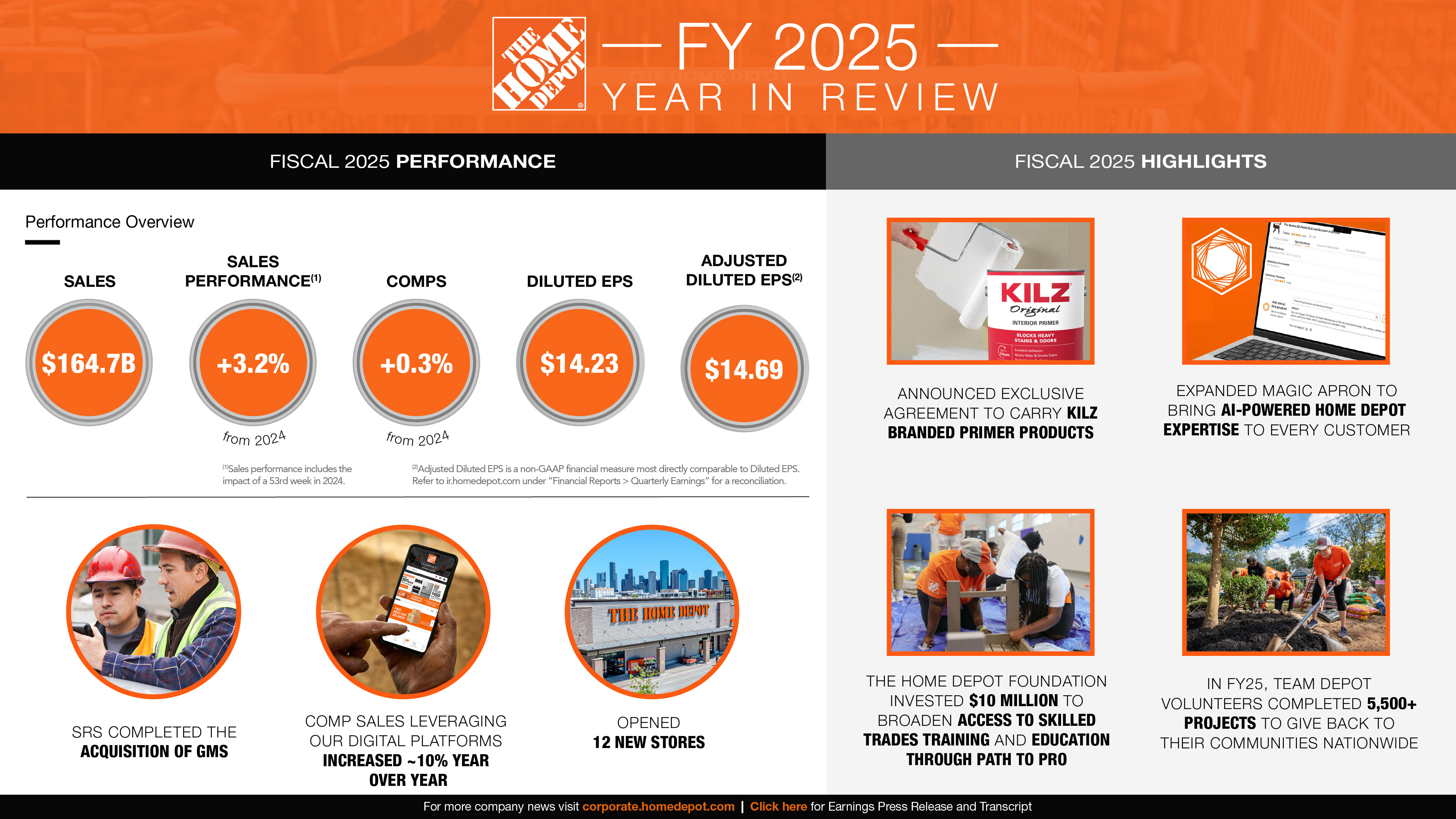
On February 24, 2026, Home Depot reported its fourth quarter and full-year fiscal 2025 results, and the numbers tell a story of resilience in a challenging macro environment. For the full fiscal year, sales rose 3.2% to $164.7 billion, up from $159.5 billion in fiscal 2024. Comparable sales increased 0.3% globally and 0.5% in the U.S., underscoring the company's ability to take market share even as the housing market remained under pressure.

In the fourth quarter alone, sales came in at $38.2 billion. While that represented a 3.8% decline from the prior year's comparable period, the decrease was primarily due to the calendar shift — Q4 fiscal 2025 consisted of 13 weeks versus 14 weeks in fiscal 2024, which added approximately $2.5 billion to the prior year's quarter. On a comparable basis, sales actually increased 0.4%, with U.S. comparable sales rising 0.3%. Adjusted diluted earnings per share of $2.72 beat analyst estimates of $2.54 by a healthy 7.1% margin.
Net earnings for the full year were $14.2 billion, or $14.23 per diluted share, compared with $14.8 billion, or $14.91 per diluted share in fiscal 2024. The modest decline reflected ongoing consumer uncertainty and limited housing turnover, which management described as a "frozen" housing market characterized by the lock-in effect — homeowners staying put rather than selling their homes and giving up low mortgage rates.
"Throughout fiscal 2025, our teams did an incredible job engaging with our customers and growing market share," said Ted Decker, chair, president and CEO of Home Depot. "For the fourth quarter, our results were largely in-line with our expectations, reflecting the lack of storm activity in the third quarter and ongoing consumer uncertainty and pressure in housing. Adjusting for storms, underlying demand was relatively stable throughout the year."
Timeline: How Home Depot's Strategic Vision Evolved Through Fiscal 2025
August 2025: Home Depot reported solid Q2 results and declared its 154th consecutive quarterly dividend of $2.30 per share, maintaining its storied dividend streak.
November 18, 2025: The company reported Q3 results with revenue growth of 2.8% year-over-year, driven by a slight rise in comparable sales. The board declared the 155th quarterly dividend of $2.30 per share, payable December 18, 2025.
December 9, 2025: In a pivotal strategic update, Home Depot reaffirmed its fiscal 2025 guidance and, for the first time, established a preliminary fiscal 2026 outlook alongside a "Market Recovery Case" scenario. The recovery case envisioned total sales growth of approximately 5% to 6% if housing market conditions improve.
February 24, 2026: Home Depot announced Q4 and full-year fiscal 2025 results, raised the quarterly dividend by 1.3% to $2.33 per share ($9.32 annualized), and provided formal fiscal 2026 guidance.
May 5, 2026: Bank of America reinstated coverage with a Buy rating and $374 price target, naming Home Depot the preferred stock in home improvement over rival Lowe's.
Why Home Depot Matters: Bank of America's Bullish Call and the $171 Billion Opportunity
Bank of America's reinstatement of coverage on May 5, 2026, marked a significant vote of confidence in Home Depot's strategy. Analyst Elizabeth Suzuki assigned a Buy rating with a $374 price target, representing approximately 18.7% upside from current levels. The call was based on three primary pillars:
Pro Segment Strength: Home Depot has been steadily increasing its penetration of professional contractors (the "Pro" customer), who tend to be more loyal and spend significantly more per visit than DIY homeowners. BofA noted that Home Depot's Pro growth should drive comparable sales outperformance relative to Lowe's.
SRS Distribution Acquisition: The acquisition of SRS Distribution, completed in 2024, has positioned Home Depot as a dominant player in the specialized roofing, landscaping, and pool supply markets. SRS operates over 1,250 locations and is expected to deliver mid-single-digit percent sales growth in fiscal 2026, providing a meaningful growth accelerator independent of the housing cycle.
Compelling Valuation: At roughly 19 times forward earnings, Home Depot's valuation is attractive relative to historical averages, especially given the potential for a housing market recovery that could significantly boost earnings power.
The Street's other major outlets have weighed in similarly. Wolfe Research reiterated an Outperform rating with a $414 price target, following remarks from CFO Richard McPhail. Overall, analysts are broadly constructive — of the 33 analysts covering HD, the consensus price target sits at approximately $412, with a high of $470. S&P Global recently affirmed Home Depot's credit ratings with a stable outlook as well.
Wolfe Research's $414 target and Bank of America's bullish stance contrast with the more cautious view from The Motley Fool, which labeled HD a "hold" in March 2026, noting that while the company is well-managed, the timing of a housing recovery remains uncertain. This split among analysts reflects the central tension in the Home Depot investment thesis: strong fundamentals versus an uncertain macro environment.
Where Things Stand Now: Home Depot's Fiscal 2026 Guidance and Market Positioning
Home Depot management provided formal fiscal 2026 guidance alongside the Q4 earnings release. The company expects total sales growth of approximately 2.5% to 4.5%, comparable sales growth of approximately flat to 2.0%, and diluted earnings per share growth of flat to 4.0% from the $14.23 base in fiscal 2025. Adjusted diluted EPS is expected to grow at a similar pace from the $14.69 adjusted base.
The company also plans to open approximately 15 new stores in fiscal 2026, bringing its total beyond the current 2,359 retail stores and over 1,250 SRS locations across North America. The guidance implies fiscal 2026 revenue in the range of approximately $168.8 billion to $172.1 billion, with the midpoint of roughly $171 billion catching the attention of analysts at TheStreet.
Gross margin is guided at approximately 33.1%, while operating margin is expected in the range of 12.4% to 12.6% on a GAAP basis (12.8% to 13.0% adjusted). Capital expenditures are planned at approximately 2.5% of total sales, reflecting continued investment in the business.
The dividend increase to $2.33 per quarter ($9.32 annualized) gives Home Depot a forward dividend yield of approximately 2.95% at current prices, making it an attractive holding for income-focused investors. The company has now paid consecutive quarterly dividends for 156 quarters without interruption.
What Happens Next: The Housing Market Recovery Wildcard
The single biggest variable in Home Depot's outlook is the trajectory of the U.S. housing market. The "lock-in effect" — where homeowners with sub-4% mortgage rates are unwilling to sell and take on a new mortgage at current rates — has suppressed existing home sales and, by extension, the home improvement spending that typically accompanies home moves.
Home Depot has acknowledged this dynamic directly. In its December 2025 strategic update, the company outlined both a base-case outlook and a "Market Recovery Case" scenario that envisions total sales growth of roughly 5% to 6% with comparable sales growth rebounding more sharply. If mortgage rates decline and housing turnover normalizes, Home Depot could see a significant tailwind that would make current earnings estimates look conservative.
Bank of America's price target of $374 — and Wolfe Research's even more bullish $414 target — implicitly assume that such a recovery is on the horizon. S&P Global, meanwhile, takes a more measured view, noting that it is "not forecasting a housing recovery in fiscal 2026, and we believe a potential recovery would be gradual."
CEO Ted Decker and his leadership team have positioned the company to benefit regardless of the timing. The SRS Distribution acquisition gives Home Depot exposure to the specialized trades market, which is less tied to housing turnover and more dependent on weather, home ages, and insurance dynamics. The company's growing focus on the Pro customer, its digital sales capabilities, and its 470,000-person workforce provide multiple levers for growth.
The Bottom Line: Key Points to Remember
- Record revenue: Home Depot generated $164.7 billion in fiscal 2025 sales, up 3.2% year-over-year, demonstrating market share gains in a challenging housing environment.
- Dividend growth: The 1.3% dividend increase to $2.33 per quarter marks the 156th consecutive quarterly payout, reinforcing Home Depot's status as a Dividend Aristocrat.
- Wall Street confidence: Bank of America named HD its top pick in home improvement with a $374 target, while Wolfe Research set a $414 target. The consensus analyst price target stands at approximately $412.
- SRS acquisition payoff: The SRS Distribution acquisition is a key growth driver, adding over 1,250 specialized locations and a mid-single-digit growth stream independent of the housing cycle.
- Housing market risk: The biggest uncertainty is timing of a housing recovery. A rebound in home turnover would provide a substantial earnings tailwind that could push HD well above current guidance.
- Valuation appeal: At roughly 19x forward earnings, Home Depot trades at a discount to its historical average, making it a potentially attractive entry point for long-term investors willing to wait for the housing cycle to turn.