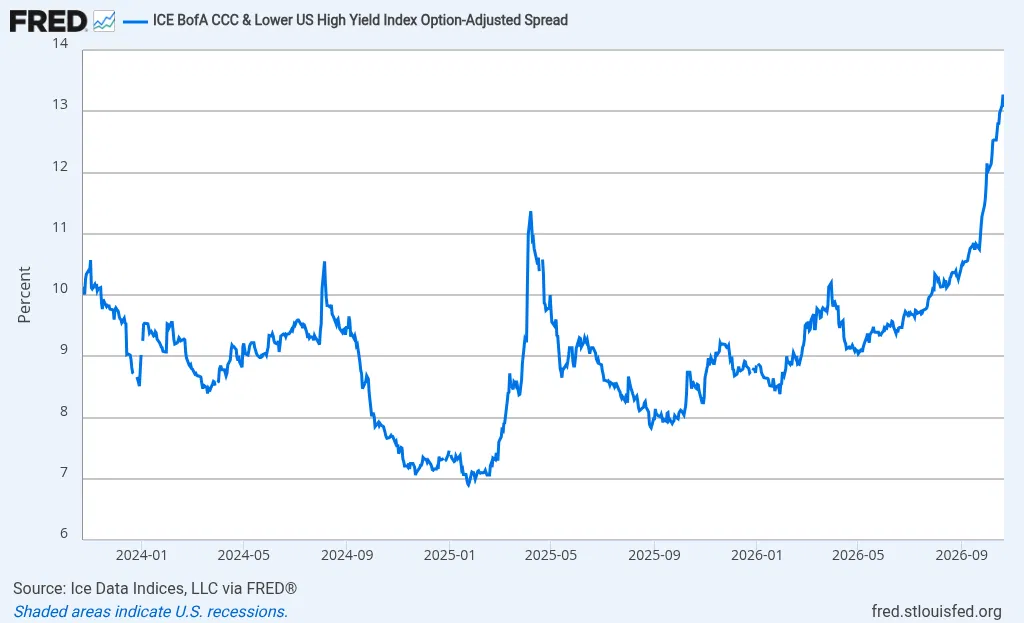
Credit markets have entered what strategists are calling "uncharted territory" — and the clearest warning is coming from the riskiest corner of the bond market. Spreads on CCC-rated bonds, the lowest rung of "junk" debt, surged to 12.97 percentage points over comparable U.S. Treasurys on Friday, October 16, before climbing further to 13.10% on Monday, October 19, according to Federal Reserve Economic Data (FRED). That marks a multi-year high and a sharp break from the calm that has defined credit through much of 2026. For investors, the message is straightforward: stress is building among the weakest corporate borrowers even as higher-quality debt has barely budged.
The Divergence That Has Credit Strategists on Edge
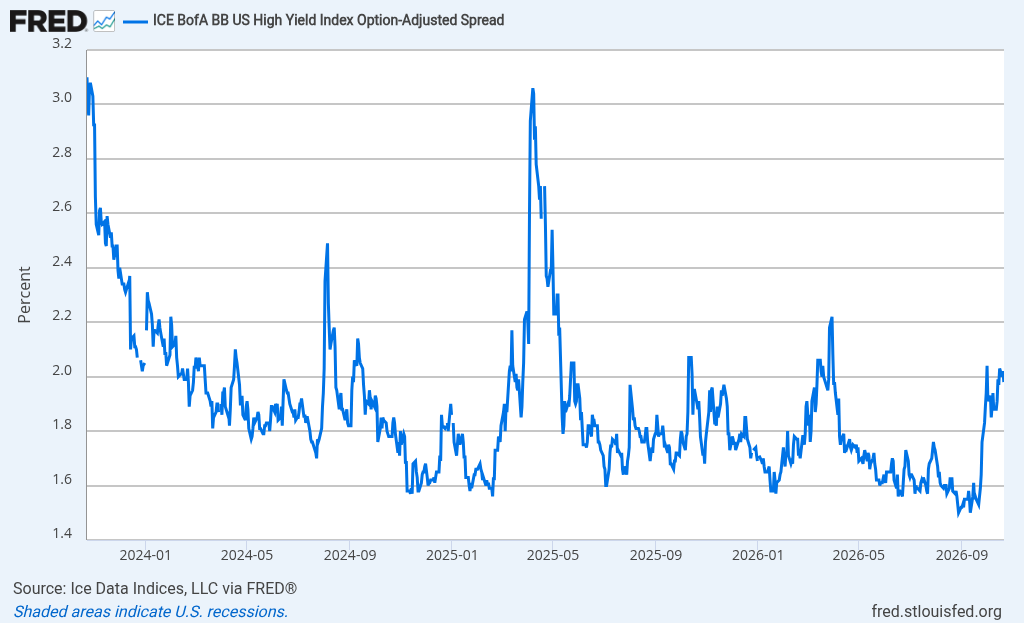
What makes this move unusual isn't just how far CCC spreads have climbed — it's how little the rest of the market has moved. According to MarketWatch, spreads on CCC-rated debt widened roughly 131 basis points over a recent one-month stretch, compared with just 5 basis points for higher-quality junk bonds. The riskiest borrowers are being repriced dramatically while BB- and B-rated bonds, and investment-grade corporate debt, have stayed mostly stable. The contrast is stark: BB-rated spreads sat near 2.00% on October 19, barely changed from 1.95% a year earlier, even as the CCC cohort blew out past 13%.
"Junk is mostly BB borrowers these days, so CCC spreads can blow out while the index barely moves," RIA Advisors chief investment strategist Lance Roberts noted on X. "If BB spreads start widening too, that's the real warning." That nuance matters: the widely followed high-yield index is dominated by BB-rated bonds, which is why overall spreads have widened a relatively modest 63 basis points since year-end to 329 basis points, according to Pensions & Investments — even as the CCC cohort has effectively entered a distressed regime.
How Credit Stress Crept Back Into the Market
The warning signs have been building for weeks:
- October 2: Bloomberg reported that global corporate bond spreads widened the most since March, with risk premiums at their highest levels in half a year as a wave of jumbo deals struggled to find buyers.
- October 9: CNBC warned that junk bonds were "flashing yellow," as investors demanded higher payouts to own the market's riskiest debt.
- October 15: Penn Mutual Asset Management flagged that CCC spreads had reached a multi-year high, "suggesting investors are becoming more cautious toward the weakest corporate borrowers."
- October 16–19: CCC spreads climbed to 12.97% and then 13.10%, prompting MarketWatch to declare that credit markets had entered "uncharted territory."
Behind the move sits a cocktail of elevated interest rates, lingering inflation pressure and — most importantly — an unprecedented corporate borrowing boom that has left companies far more leveraged than they were a few years ago.
Why the Riskiest Borrowers Are Cracking First
The root of the stress traces back to the biggest corporate debt binge in history. Global corporate issuance hit a record $13.7 trillion in 2025, according to the OECD, while U.S. investment-grade issuance alone reached $2.2 trillion through September 2026 — up 24.5% year over year, per SIFMA. A meaningful slice of that debt has funded the artificial-intelligence buildout: analysts at RP Investment Advisors estimate $140 billion to $220 billion of AI-related borrowing this year alone.
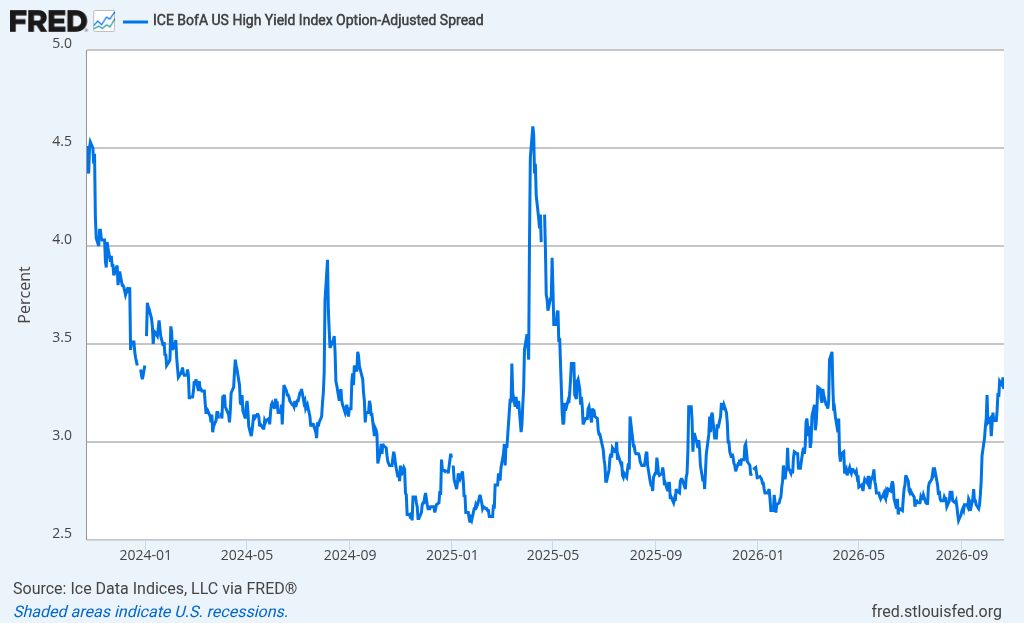
All that borrowing leaves less margin for error. Reuters calculates that roughly $4.3 trillion of non-financial corporate bonds issued in U.S. markets will mature between 2027 and 2031 — a refinancing wall that will test borrowers precisely as rates stay higher for longer. Companies rated CCC or below are the most exposed: they tend to carry the thinnest cash buffers and the heaviest interest burdens, which is why they are the canary in the credit coal mine.
The strain is not confined to public markets. Private credit — an asset class that has exploded from roughly $300 billion in 2010 to about $2 trillion today — is drawing fresh scrutiny. The European Central Bank warned in May of "concerns about credit quality and concentrated exposures," while JPMorgan CEO Jamie Dimon cautioned that losses in the sector could be "larger than expected." Rating agencies estimate leverage in private-credit deals runs at roughly twice the average for public high-yield bonds, according to Allianz Global Investors.
Consumer credit is flashing its own warning. Americans' credit card balances hit a record $1.28 trillion in the fourth quarter of 2025, the New York Fed reported, as higher rates squeezed household budgets. When both consumers and the weakest corporations are stretched at the same time, credit investors usually take notice.
Where Credit Markets Stand Right Now
As of October 19, CCC spreads sat at 13.10 percentage points over Treasurys — a level historically associated with rising default expectations. The damage is already visible in returns: CCC-rated bonds are down roughly 27% so far this year, according to MarketWatch, a sharp contrast to the modest performance of higher-quality credit. Yet the picture is not uniformly dire. Barclays noted that net corporate leverage actually declined to 2.8 times EBITDA and interest coverage ratios remain comfortably above 13 times, suggesting the broad market is not yet in a full-blown distress cycle. For now, the stress is concentrated in the lowest rungs of the credit ladder.
That concentration is exactly why some strategists are watching the next rung up. "CCC spreads have widened significantly, while BB and B spreads have only recently started moving higher," Roberts observed. If BB-rated spreads begin to gap out, it would signal that stress is migrating from the weakest borrowers into the heart of the high-yield market — a far more consequential development for portfolios.
What Investors Should Watch Next
The road ahead hinges on three signals. First, keep an eye on BB-rated spreads: sustained widening there would confirm the stress is broadening beyond the weakest borrowers. Second, watch default rates — they remain low by historical standards, but the maturity wall in 2027–2031 and the AI spending cycle will determine whether they stay that way. Third, monitor private-credit fund flows and redemption requests, which the ECB and Dimon have both flagged as potential transmission channels if losses begin to materialize.
For income investors, the takeaway is not to abandon credit entirely but to be selective. Higher-quality segments still offer historically attractive yields with relatively stable fundamentals, while the riskiest CCC cohort is now pricing in meaningful distress. As MarketWatch put it, the bond market's "silent alarm" is ringing — and the loudest part of it is coming from the bottom of the quality spectrum.
The Bottom Line: What Credit's Warning Signal Means
- CCC-rated junk bond spreads hit a multi-year high of 13.10% over Treasurys on October 19, entering what MarketWatch calls "uncharted territory."
- The divergence is the story: CCC spreads widened roughly 131 basis points in a month versus just 5 basis points for higher-quality junk.
- A record corporate borrowing boom — including up to $220 billion in AI-related debt — has set up a $4.3 trillion refinancing wall between 2027 and 2031.
- Private credit, now a $2 trillion market, is under scrutiny, with Jamie Dimon warning losses could be "larger than expected."
- The key signal to watch next: if BB-rated spreads start widening, stress is spreading beyond the weakest borrowers.