
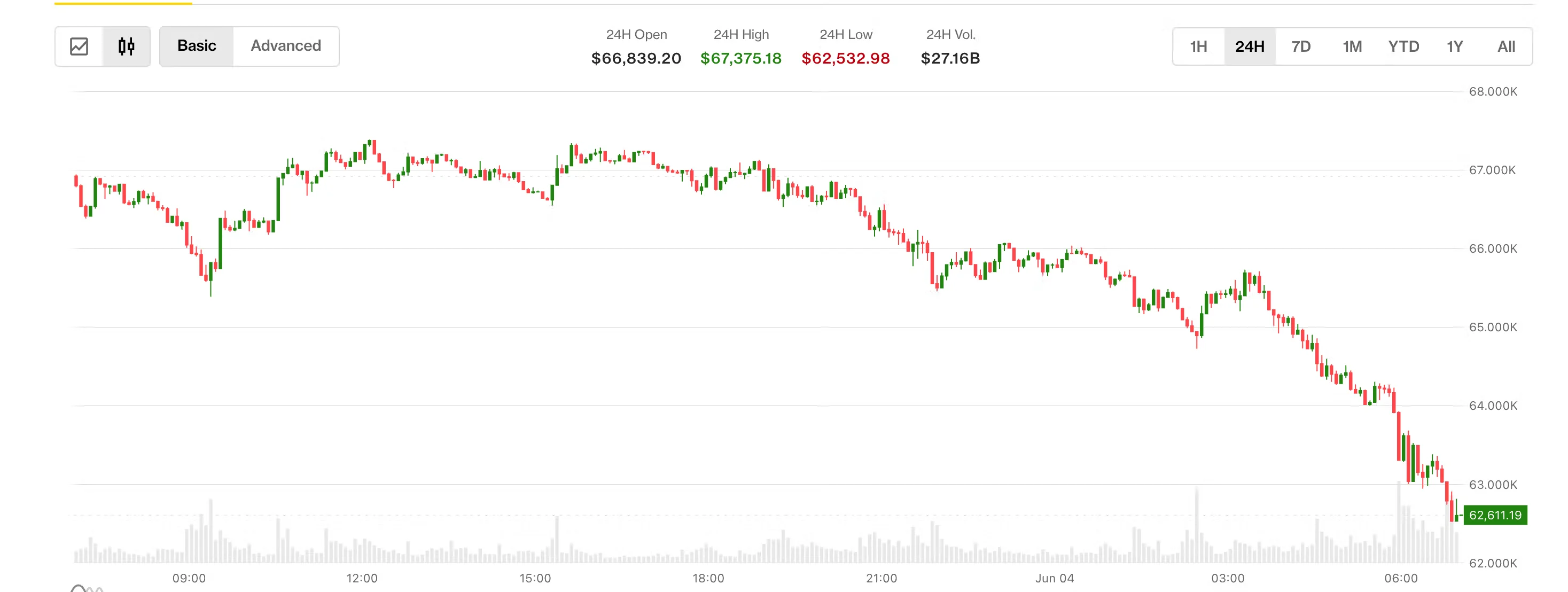
Bitcoin has tumbled below $63,000 for the first time since February 2026, extending a brutal selloff that has erased more than 50% of its value from the October 2025 all-time high. The cryptocurrency now trades near $62,945, down more than 14% in a single week and roughly 21% over the past four weeks, according to CoinDesk data. For investors watching the crypto space, the selloff represents one of the most significant drawdowns since the 2022 crypto winter.
How the Bitcoin Selloff Unfolded: Record ETF Outflows and a Historic Strategy Sale
The current downturn began quietly in late May but accelerated sharply in the first week of June. The most significant catalyst has been an unprecedented exodus from U.S.-listed spot Bitcoin ETFs. According to data tracked across multiple sources, spot Bitcoin ETFs recorded a historic $3.4 billion in net outflows during a single week in June 2026, marking the largest withdrawal event since these funds launched in January 2024. The outflow streak has now reached 13 consecutive trading days, signaling a clear shift in institutional sentiment.
Adding to the psychological weight, Strategy (formerly MicroStrategy) disclosed in an SEC filing that it sold 32 Bitcoin between May 26 and May 31, raising approximately $2.5 million. While the amount was negligible relative to the company's massive holdings, the symbolic significance was immense. Strategy had maintained a strict "never sell" doctrine under executive chairman Michael Saylor for nearly four years. The sale rattled markets already on edge. However, in a dramatic reversal that underscores the complexity of this market, Strategy quickly repurchased 1,550 Bitcoin days later, demonstrating that the company's long-term conviction remains intact.
Timeline: From October Peaks to June Panic
October 2025: Bitcoin hits its definitive all-time high near $125,000, driven by post-election optimism and pro-crypto policy signals. Institutional inflows through ETFs peak at record levels.
November 2025: The first signs of trouble emerge. The U.S. Labor Department's nonfarm payroll report triggers a sharp correction. Bitcoin drops 30% from its peak. Deutsche Bank warns that this selloff may be harder to bounce back from than prior declines.
February 2026: Bitcoin briefly dips below $63,000 as tariff announcements and macro uncertainty trigger what analysts at VanEck describe as "orderly deleveraging rather than capitulation." The asset bounces from the $60,000 support zone.
May 2026: ETF outflows accelerate. IBIT (BlackRock's Bitcoin Trust) records $2.43 billion in net outflows over nine consecutive sessions. Cumulative ETF inflows, which had reached roughly $58 billion, begin shrinking rapidly.
June 1-3, 2026: Strategy sells 32 BTC for the first time in four years. Bitcoin drops below $70,000, then crashes through $65,000. The 30-day implied volatility index (BVIV) jumps to 53.17, its highest since early April.
June 4, 2026: Bitcoin breaks below $63,000 for the first time since February. Open interest falls 17% in 30 days to $51.5 billion. Total crypto liquidations exceed $1.2 billion in a single 24-hour period.
June 8, 2026: Bitcoin trades near $62,945, with analysts closely watching the $60,000 support level. Strategy announces purchase of 1,550 BTC, providing a glimmer of institutional confidence.

Why This Selloff Is Different: Expert Analysis and Market Impact
This Bitcoin downturn has multiple layers that distinguish it from prior corrections. Unlike the 2022 crypto winter, which was driven primarily by crypto-native failures (Terra, FTX), the current selloff is being driven by macroeconomic forces and institutional behavior.
"A broad sell-off in crypto, which started with Strategy's transfer triggering ETF outflows and is now fueled by speculative news about Mt. Gox liquidations, signals a potential continued sell-off," said Paul Howard, senior director at liquidity provider Wincent. "BTC at $50k is a level some are starting to talk about as a bottom this year."
The macroeconomic environment has shifted dramatically. Escalating US-Iran geopolitical tensions have raised concerns about energy prices and global trade routes, including the strategic Strait of Hormuz. Inflation fears have resurfaced, and the Fed's policy path remains uncertain. Meanwhile, rotatation of institutional liquidity into artificial intelligence and other tech sectors has drained capital from crypto markets.
"Whilst there is a long way to go, the absence of catalysts and the movement of liquidity into other tech sectors such as AI indicate we have further volatility ahead," Howard added.
On-chain data, however, tells a more nuanced story. Despite the price decline, long-term holder metrics show resilience. The number of Bitcoin addresses holding for more than one year continues to rise, suggesting that retail and long-term investors are not panicking. The February 2025 and February 2026 crashes both saw prices nearly test the $60,000 level before finding support, and analysts at Material Indicators point to this as a critical technical zone:
"The first major zone we're watching is the low $60k region, because that is where a lot of important pieces start coming together. We have the local low around $59.9k. We have the 200-week moving average now sitting in that same general area. That does not guarantee support. It simply tells us this is where the market should have to make a decision."
Where Things Stand Now: Latest on the Bitcoin Market
As of June 8, 2026, Bitcoin is trading in a narrow range between $62,500 and $63,200, attempting to stabilize after the sharp decline. The 30-day implied volatility index remains elevated at 53.17, reflecting continued uncertainty. Cumulative outflows from spot Bitcoin ETFs have now exceeded $4.4 billion over 13 trading days.
On the positive side, Strategy's decision to buy 1,550 Bitcoin following their small sale signals that the largest corporate Bitcoin holder still sees value at current levels. The company's total holdings now exceed 500,000 BTC, worth approximately $31.5 billion at current prices. This institutional vote of confidence provides a partial buffer against further downside.
The futures market shows open interest down 17% month-over-month to $51.5 billion, indicating that leveraged positions have been largely flushed out. This deleveraging could set the stage for a more sustainable recovery, as it did following similar corrections in prior cycles.

What Happens Next: The Road Ahead for Bitcoin Investors
Looking ahead, analysts are divided on Bitcoin's near-term trajectory. The base case from most market observers is not a catastrophic crash but rather continued consolidation and potential further downside toward the $60,000 support level. A break below that could trigger a move toward $50,000, which some traders have identified as a potential bottom for this cycle.
Industry executives and investors surveyed by CNBC in January 2026 forecast a wide range for Bitcoin in 2026, from as low as $75,000 to as high as $225,000. Those predictions now appear optimistic given the current price action, but the long-term outlook remains positive for many. Grayscale's 2026 Digital Asset Outlook called this "the dawn of the institutional era," while Bitcoin Suisse predicted Bitcoin could approach $180,000.
Key catalysts that could reverse the current trend include: a resolution of US-Iran geopolitical tensions, a shift in Fed policy toward rate cuts, renewed ETF inflows driven by institutional rebalancing, and the halving-induced supply squeeze continuing to affect available liquidity.
The Bottom Line: Key Takeaways for Crypto Investors
- Bitcoin is trading near $63,000 after a 50% drawdown from October 2025 highs, driven by record ETF outflows, Strategy's symbolic BTC sale, and macro uncertainty
- The $60,000 level represents critical technical support, with the 200-week moving average converging in the same zone
- Institutional demand via ETFs has weakened significantly, with 13 consecutive days of outflows totaling over $4.4 billion
- On-chain metrics show long-term holder resilience, suggesting the selling is concentrated among shorter-term and institutional participants
- Strategy's rapid repurchase of 1,550 BTC demonstrates continued corporate conviction at current price levels
- For long-term investors, the current drawdown may present a buying opportunity, but near-term volatility is likely to persist